Showing posts with label speaking. Show all posts

Saturday, April 05, 2014

Observing ourselves with technology

I gave my students the opportunity to observe their own behavior this past week. We have been working on sight words quite a bit lately. Now that texts are getting a bit harder with less cvc words and more words that can't be sounded out, sight words need to be automatic when reading. I found a great way for kids to practice sight words at Teacher Tipster. (By the way, all of his ideas are great and I have used quite a few including Sight Word Jenga and Silly-brations, plus he is so fun! :D )

One Breath Boxes is my latest find. Check out the links below for more info.

I gave students the chance to practice with partners or in small groups. We practiced first together how to take turns. One person reads first and the other checks the words. If the person gets a word wrong, the checker has to stop them and tell them they missed a word. I made sure to emphasize that we all want to get all the words right, but if we miss one we want to know so we can fix it for next time. I then went around the room to record students practicing with each other. We then got back together as a group and watched/listened to ourselves. They had to follow along with the video/audio recordings to check if they were right. I had one student who kept saying 'came' instead of 'can.' When a friend or myself would stop to correct, he insisted that he did in fact say 'can.' Of course, we said "No, you said 'came.'" This goes back and forth for a while, until we pull out the video of him saying the words. Now the student can hear and see himself say the wrong word. "Oh! I guess I did say that!" That's what I love about using technology as a learning tool - it forces students to look at themselves. When we have knowledge of ourselves in the present, we can make a better attempt at improving for the future.

Breath Box #1 by First Grade


Tuesday, February 04, 2014

Lego Stories

These Lego personal narratives were created by my 3rd, 4th, and 5th grade ENL students. This was our first attempt at making digital presentations on our iPads. Students brainstormed ideas, wrote their story, edited and revised, created a storyboard showing each scene, drew backgrounds, constructed buildings, vehicles and other props, took pictures of their scenes, and finally narrated their whole project. We created our final projects on the VoiceThread app.

I created a Pinterest board with all of our stories. Check it out at: http://www.pinterest.com/saragalbreath/lego-stories/


Monday, April 29, 2013

Final Reflection for CEP 811

“There is no end to education. It is not that you read a book, pass an examination, and finish with education. The whole of life, from the moment you are born to the moment you die, is a process of learning.” - Jiddu Krishnamurti

It is such an exciting thought for me to know that learning will never end. Education is not confined to a book or a class, but extends to all experience. Learning is my fuel and it brings satisfaction, curiosity, and wonder to my life. Where will the journey of learning take me? What new and interesting ideas will I discover next? What kind of new technologies will help to expand my learning and the learning of my students? I do not know the answers to all of these questions, but I do know that the journey so far has been a fulfilling one. I know that the future quest for knowledge will be just as rewarding. I thoroughly enjoyed experiencing my first two online courses this semester with CEP 810 and CEP 811. These courses have given me many things including new friends, new tools, and new ideas. More than anything, my online learning through MSU has renewed my deep love of personal learning. The new knowledge I have gained will not just stay personal, but has given me a reason to share what I have learned with my students and colleagues. What are some of the things I have learned during this course and what contributed to that learning?

One of the most important things I learned this semester is the incredible potential that the Internet affords for collaboration. With all the social media outlets available, connecting with others near and far has never been easier. Throughout this semester I participated in different kinds of social media, including email, discussion forums, blog posting and commenting, and Google Hangouts. In truth, I probably would not willingly choose to be a part of most online social networks. I tend to be a pretty private person and often try to avoid large social gatherings. This course has helped me to reach out to others for support and required that I rely on people outside of my normal circle of acquaintances. This has helped me to see first-hand the wealth of personal and professional contacts that can contribute to my own learning, not to mention the vastness of ideas and resources that I use on a daily basis in my own classroom and at home.

A major component of my classroom is using brain-based ideas and research to plan my lessons. The majority of resources used for these activities are found online. In addition, this course has deepened my understanding of the connections between the brain, learning, and technology through TPACK. I was briefly introduced to TPACK during an undergraduate technology course. Through the readings and videos this semester, as well as collaboration with peers for our group assignments, I now understand that to be the most effective teacher I need to address technology, pedagogy, and content in my classroom. I want to be the best I can be and TPACK, along with the NETS, CCSS, and other research-based resources, offers a workable framework to help guide and plan my lessons. I appreciate the structure that these resources provide while allowing me to teach these standards in a way that best meets the needs of my students.

Throughout the course, I have had the opportunity to create several meaningful instructional technology-based resources for my students. Over the past few weeks, I have implemented my "Can you hear it?" StAIR, "We know how to..." WebQuest, and my UDL enhanced lesson plan into my own classroom. These are useful tools that I created specifically for my students. I feel such a sense of pride when I see what I have created! It is even more rewarding when I see students engaged in learning with the resources I created! I know that in-depth tech-based projects will help my students practice and apply real world communication skills. My WebQuest and UDL lesson plan focus on students creating a how-to video. Each week since Spring Break we have focused on a specific aspect of our how-to writing project including brainstorming, planning, sequencing, writing, revising, editing, adding pictures and adding audio. Every week students are utilizing technology tools to enhance learning, while creating a meaningful product that demonstrates their knowledge. A few of my groups have already completed their projects! I am so pleased with their work! I will be sharing some of the finished videos with my principal and school board this week!
Here are the links to a few:

1st grade - I know how to tie my shoes.
2nd grade - I know how to make a book.

As I look to the future, I still have so much I want to learn about technology! This summer, I am looking forward to attending eQuip 2013. I went last year and it was a blast. I will also be attending a few Project Based Learning workshops, as I believe technology and PBL go hand in hand. I also have a personal goal of compiling a list of Google Play apps for my colleagues based on grade level and subject. We were issued Kunos in December, but unfortunately have not received any training. To help compensate, my second Tech Tuesday will be on May 21st and we will focus on how to use our Kunos for teaching and learning. I also plan to continue to update my Tech4Parkside website with more links and information for my colleagues. In addition, I would like to categorize my list of apps to match the four main areas of language acquisition and the specific skills tested on the LAS Links assessment. I am excited to put this list together because I know these resources will help my students increase their English proficiency. I want to offer my students a variety of opportunities to practice the communication skills they need to be successful. I am also excited about tinkering with MIT’s App Inventor this summer. I have always wanted to make my own apps and hopefully this summer I will!

I know that my learning does not end with CEP 811 this week. It will continue with CEP 812 next week, then CEP 822 later in the summer. I have been accepted into the MAET program and then eventually plan to pursue my Doctorate in Educational Psychology and Educational Technology at MSU. My learning is not isolated to formal schooling as I know the best way to learn is to experience. My goal is to continue to seek out new opportunities to grow as a person and as an educator.


Friday, October 19, 2012

Grab Bag

Here is a fun and easy activity to help your language learning students practice using describing words or adjectives.
  1. Gather several bags of many sizes. The bags should be opaque so students cannot see through them. I usually can find fun bags in the dollar section of Target or you might check at your local dollar store.
  2. Gather items from around your classroom, school, or home. Be sure the items can fit comfortably inside a bag. You will need one item per bag. Try to find items that have interesting textures.
    Here are the items I used: teddy bear, keys, plastic fork, roll of toliet paper, toy car
  3. Label each bag with a number for easy identification.
  4. Prepare a simple T chart. I like to create a digital version like this one or you can use an online version like this one. One side should be labeled "It is" and the other side should be labeled "It has."
  5. I like to lay some basic ground rules for this activity because students get excited and can get silly. Here are my rules that we go over before starting.
  6. Now it is time for the fun! Pick a bag to start with. One at a time, students will reach their hand into the bag to feel the object inside. They will think of one adjective to describe the object. Students will need to decide which side of the T chart their adjectives belongs. You could do this part several ways. I like to have students come up to the computer and type their adjectives in the appropriate box. You could also have them write their adjectives on sticky notes and add to a paper chart or digital chart projected on a screen. The student then has to read their sentence. Examples: It is furry. It has a tail. I also like to have students make the T chart on paper or on white boards to help keep track of ideas.
  7. After all students have had a turn, as a group you should review all the adjectives. Tell students that these are all clues to help them figure out what is inside. Students will then write a sentence telling what they think is inside the bag. Ex: I think there is a bear inside the bag.
  8. Finally, we open the bag and see who guessed correctly! The class goes wild and we have a good five minute chat about what we thought it was and why, if we were wrong or right and why, and the importance of adjectives to give us information.
  9. If time, repeat with a new bag!
The students always have a great time with this lesson and it takes hardly any time at all to put together. This is one of my most requested activities. It is so simple to switch out the bags for new items. I thought for next time to have students bring in a secret object to share. How fun would that be! :D

Friday, October 12, 2012

Can You? Yes, I Can!

Person #1:   ______, can you ____________________?
(Insert the student's name and some kind of activity that the student can do. Here are some ideas: hop, skip, do jumping jacks, growl like a bear, find the letter T, point to your ear, crawl, etc. You get the point!)
Person #2: Yes, I can ____________________!
(This person should answer and repeat what was requested of them. Then they will do the activity.

Example:
#1: Juan, can you touch your toes?
#2: Yes, I can touch my toes! (and then he shows me)

This is a great simple activity to use with language learning students. With this activity we practice a lot of different communication skills. One of the hardest things for kids, especially young ones and language learners, is answering a question in a complete sentence. I bet you have heard this before. How are you? Good. We should really be encouraging our students to speak in full sentences even to answer a question. I like to write the sentence frame on a sentence strip and then laminate it so we can reuse it. We can then write the name and activity on the sentence strip, and then read what we wrote. Then we can erase and think of another activity. Be sure that students get the opportunity to ask and answer questions during this activity. Also, it is a good idea to have a list of actions or activities for students to choose from in case they get stuck. Sometimes it is hard to come up with ideas off the top of your head!

Here are the skills we practice with this simple activity:
  • Orally asking questions
  • Orally answering questions in complete sentences
  • Exchange of dialogue between two people
  • Sentence structure and grammar
  • Listening comprehension
  • Speaking with expression

Monday, October 01, 2012

Third Type of Student Response: Question

Last Monday, we had a professional development day at Lakeland High School. We worked in teams to create SLOs and worked on self-evaluations. It was great to have a day to catch up on all the paperwork. Wednesday we had an ENL meeting after school. I am excited about some upcoming ENL conferences. The first one is next Saturday, October 6th. I will be driving down to Indy for the INTESOL conference. It will be great to collaborate with other ENL educators! It was a short week, but it was very full!

This week, I introduced the third and final (as of right now :P) structured student response: question. By far, this response was the most challenging for students. Students are very often brimming with questions, but when requesting questions about a certain topic or about what we just heard, students were not sure where to start. I am going to reteach this student response and give students more practice with it next week. The whole point of question is to get students to think about where their prior knowledge and experiences END. We have finite knowledge and question helps us to find out more.

Question - I want to know more.
Left hand pointer finger points to the top middle of your head. Right hand pointer finger points to your belly button. When I look at you, I should "see" a question mark.There are several types of questions; factual, clarifying, opinion. Factual questions can be found right in the text or by asking a person directly. What color is Greg's hat? We can find that answer by looking at his hat. The answer is right there. Clarifying questions are asked when we heard or read something, but don't understand it. Where does my homework go? Opinion questions are asked when we want to know what someone thinks. Do you like spinach? There is no right or wrong answer here, but just a personal viewpoint.

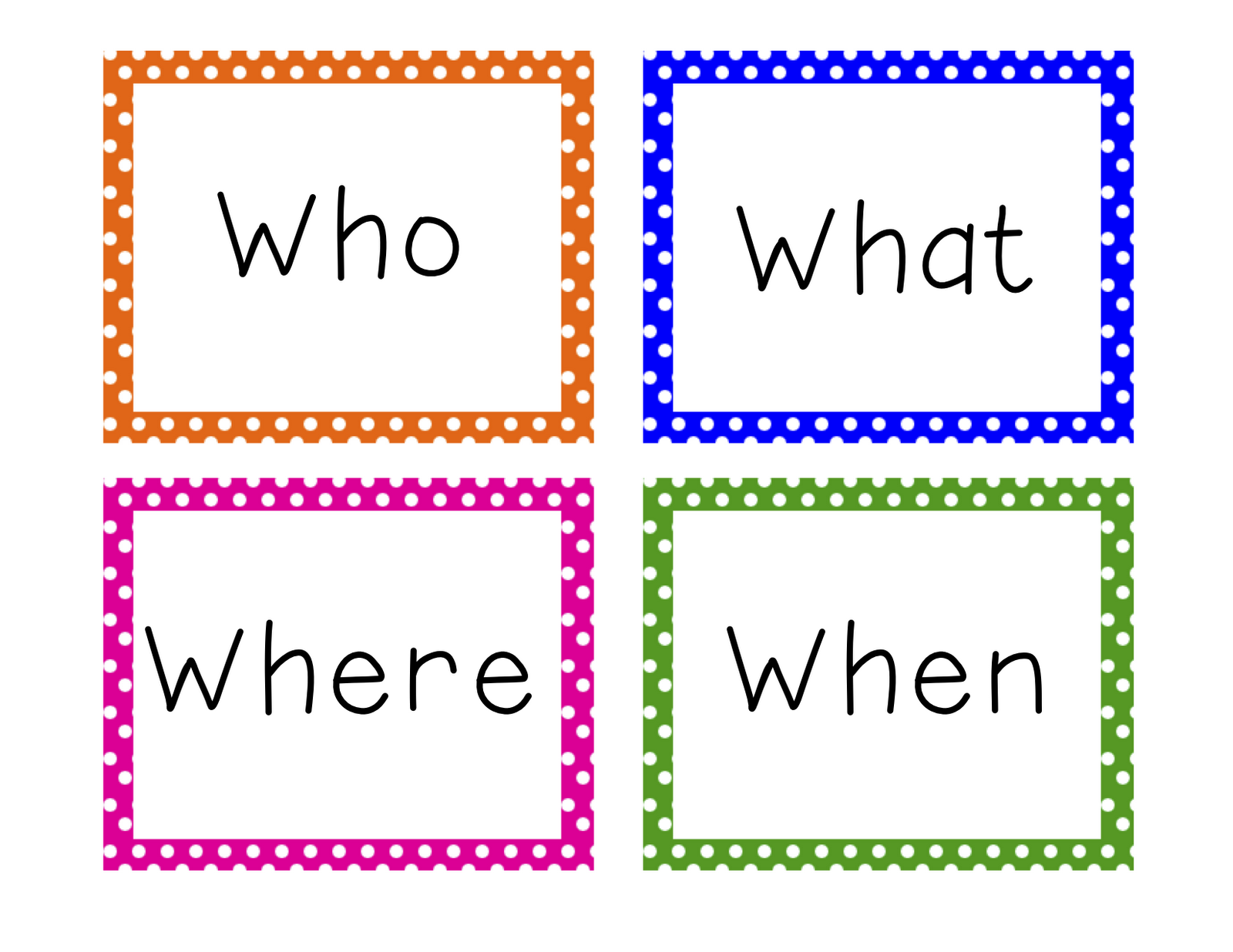
For this first introduction, we mostly focused on factual and opinion questions. We looked at different question words that can start a sentence; who, what, where, when, why, how, do, did, does, can, may, are, etc. Click here for my question word cards. Students practiced asking each other questions and forming answers for those questions. We also worked on follow-up questions if we want even more information. We looked at different ending marks used for question and statement sentences.

Up next: Technoloy Week - I will be using computers in my lessons all week next week. Stay tuned for cool tech tool links!

Monday, September 24, 2012

Second Type of Student Response: Connect

Doesn't it just feel so great when you plan a lesson and it goes smoothly, the kids have a good time and, are enjoying the process of learning?! I love it when that happens! My students did such an amazing job this week! We deepened and extended our ability to listen to and repeat sentences. I felt they were ready for the second type of structured student response: connect.

Connect - That reminds me of ...
Use your pointer fingers and thumbs to make circles. Open one circle and put it around the other circle. Close fingers to make two loops like a chain link.
Connect is all about prior knowledge. I am using the quote, "That reminds me of..." on the poster. Students come to us with so much knowledge already in their brains. Why not use that knowledge and build upon that foundation with new knowledge. It takes me all the way back to Ed Psych, my favorite undergraduate class. The official term for using background knowledge is scaffolding.  It is much harder to teach a concept if we start from scratch without any experience on that topic. Using what students already know to enhance learning makes it relatable and meaningful. For my purposes as a language learning teacher, when students share their previous knowledge it gives me a glimpse of their experiences and where gaps exist in their vocabulary and language development. They may have experience with an idea but are lacking the language skills to convey that idea to the group. Our small group meetings are designed to give students the opportunity to practice their language skills in a low-stress and encouraging environment.

To introduce connect this past week, I had a variety of picture cards. For this introductory activity I wanted students to just share what the picture made them think about. If we had a picture of a pillow, students would say that it made them think about sleeping, their bed, or being comfortable. Those are great connections. The picture did not show a bed or someone sleeping, but the students already had experience with pillows and what they are used for. I plan to extend connect past just recalling previous knowledge or experiences. When we connect to texts we use TTS (text to self), TTT (text to text), and TTW (text to world). I want to use connect as a language development tool and as a structured student response to encourage listening and speaking about our own ideas and the ideas of others. We just touched on this skill this week and will be practicing more in the coming weeks.  Click here for the poster on TpT. Stay tuned for next week's new skill: Question.

Thursday, September 13, 2012

First Type of Student Response: Repeat

This week I started my full pull-out schedule. It was great to meet all my kiddos! I definitely have some fun characters in this bunch. What I find to be the most challenging so far is switching gears for each grade level. At one point during each day I am going from Kindergarten then to Fifth Grade. As you may know, those two grade levels are quite different! At least it keeps things interesting and is stretching me to be flexible!

This week I introduced the first of three structured student responses. During group time, we practice listening and speaking A LOT. We then practice writing down our ideas, reading and re-reading our own writing, and reading the writing of others. We talk a lot about what a good speaker sounds like and what a good listener looks like. To encourage students to listen to each other I devised three simple structured student responses. I originally saw these being used by my friend, Katie Evans, when she was teaching Kindergarten. I tweaked them a bit for my own uses and so far they have worked wonderfully! I will also be linking the posters to go with the responses. Here is the first one:

Repeat - Say what I say.
Hold up pointer finger to repeat. 
Students will repeat what they heard. It could be a word, a sentence, or an idea. This helps to practice listening for details and then using language to share what you heard. This is the most basic form of response, just a copy of what was heard. It is a great place to start. When the speaker is finished sharing, they will pick a friend to "REPEAT." The speaker continues to pick friends to "REPEAT." When everyone has had a turn, the speaker's turn is over and they pick a new friend to be the speaker. It was great to hear Kindergarteners repeat details from their friend's writing. The 3rd graders loved to be the one in charge of picking students to "REPEAT." They ran the discussion and you could tell that they were looking for friends who were really paying attention. This is my very first upload to Teachers Pay Teachers! Check it out here or click the title for the Google Doc.

I will be introducing the next structured student response next week: Connect. Stay tuned here and at Teachers Pay Teachers for more!